
Research & analytics,from theory to production.
Orionics delivers research-grade modelling and practical analytics systems, built to reduce risk, improve performance, and make complex environments measurable.
Machine learning
ML & AI research.
We develop modern ML & AI systems with a focus on robustness, deployment constraints, and verifiability — including confidential execution.
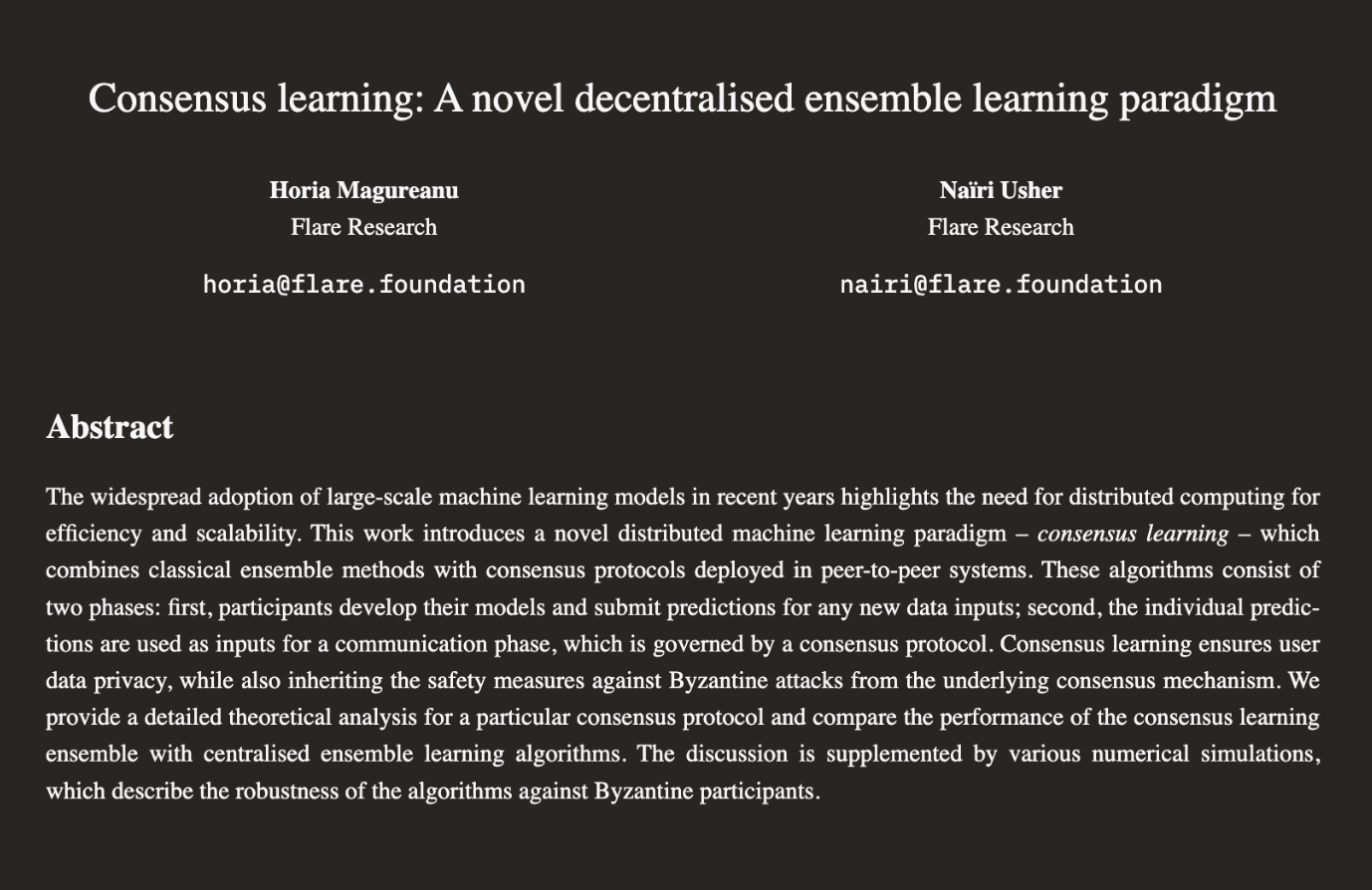
Our work on Consensus Learning introduces an ensemble learning paradigm for decentralised settings: predictions from independently-trained models are aggregated through the underlying consensus mechanism, preserving data privacy and inheriting the safety properties of that mechanism.
The same idea drives our minimal SDK template — OpenRouter running multiple LLMs that iteratively refine a final answer via consensus and self-critique. We also contributed to the Flare AI Kit, an open-source SDK for building verifiable AI agents using trusted execution environments, with the earlier flare-ai-rag template (RAG knowledge for vector databases) now being part of the kit.
Data analysis
From raw data,
to reliable decisions.
Proficient with the standard data-science stack: Python (pandas, NumPy, scikit-learn, statsmodels), SQL, as well as production deployments on GCP and AWS.
Engagements typically involve building reliable data foundations, defining KPIs and alerting, and iterating on system changes with clear before/after measurement.
Some of our work includes network performance analytics, time-series analysis, general issue investigations, or protocol optimisation work: from simple parameter changes to redesigns. Our goal is to always keep clear metrics and baselines.
Mathematics
Protocol mathematics.
We contributed to the mathematical design of Flare's enshrined protocols: the Flare Time Series Oracle (FTSOv2) and the Flare Data Connector (FDC), proving from first principles how each system stays robust under adversarial conditions.
The work covers the incentive design behind participation, with detailed game-theoretic analysis of the strategies available to honest and adversarial actors alike, as well as the weight systems used to aggregate inputs.
Interested in research-grade analytics with production delivery?